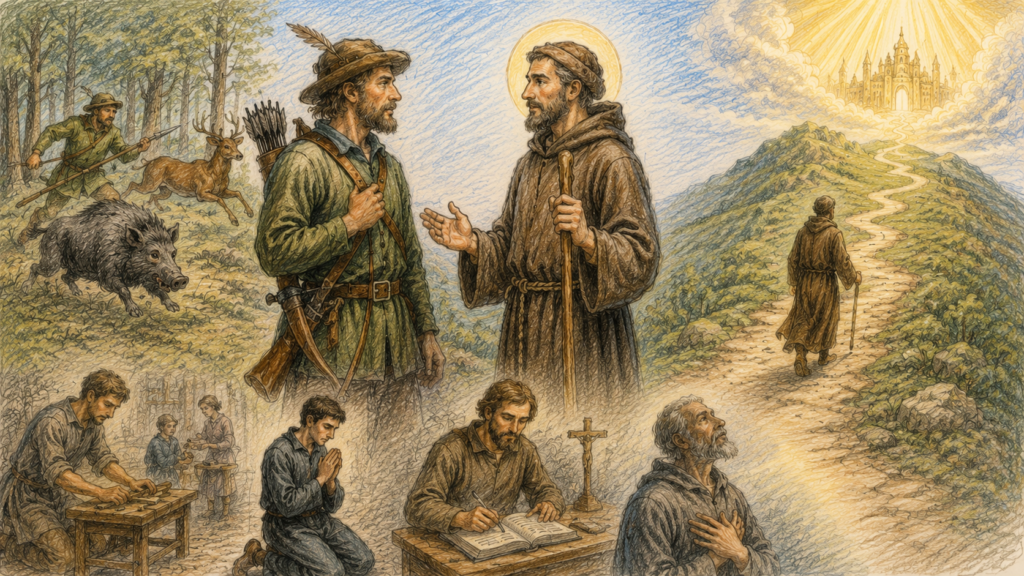
Theodorete recounts in his “Philotheus” that St. Marcian once met a hunter and asked him: “What do you do?” The hunter replied: “I hunt wild boars and deer; I run after them and pursue them until I catch them.” After saying this, the hunter asked Saint Marcian: “And you, what do you do?” Saint Marcian replied: “I too run relentlessly after holiness and will pursue it until I can attain it.”
This is how all Christians should think and act. Holiness should be the primary occupation of our lives, and all other occupations should simply be the means to achieve holiness. For it does not make sense to be Christians who are worried about the things of this world, while forgetting that for which we were created: God and holiness.
Therefore, all Christians must strive to achieve holiness; those who have just begun to walk the path of perfection—who in spiritual terminology are called beginners— who with great desire and intense longing should aspire to holiness, fleeing from all evil and from anything that might distract them from that path, yearning for the practice of virtues and getting rid of the vices that lead them down the paths of sin.
Those who have overcome the early stages of the spiritual life—who we call proficients—must also strive. They have already moved beyond the first conversion, have learned to control the attacks of nature, and lead a life of relative perfection. Yet they should not be content with this, but must continue working to grow in virtue and in the grace of God.
This also applies to the souls who have reached the third stage of the spiritual life—those whom are called perfect—although they have attained a high degree of perfection, they must not stop on the path to holiness. In this stage, as in any stage, stopping means moving backward and losing what has been acquired.
From this explanation it is clear that no matter which stage of the spiritual life a Christian is in, he must always have the desire to reach God, to grow in holiness, to progress in the spiritual life, and not to stop until he attains that perfect holiness (as did St. Marcian) which will be given to him when he reaches Paradise.