
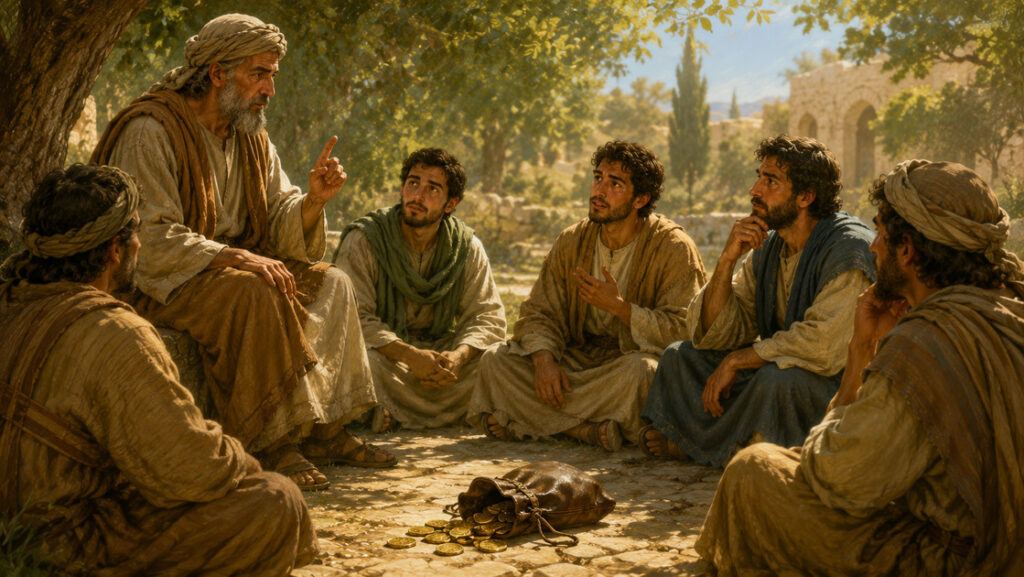
Once a master decided to test the honesty of his disciples, so he called them together and asked a question:
He said: “What would you do if you were walking along and found a purse full of money lying in the road?
“I would return it to its owner”, said one disciple. The master thought: “his answer came so quickly, I wonder if he really means it.”
“I would keep the money if nobody saw me find it,” said another disciple. The master told himself: “he has a frank tongue, but a wicked heart.”
“Well, Master,” said a third disciple, “to be honest, I believe I would be tempted to keep it. So, I would pray to God to give me the strength to resist such a temptation and to do the right thing.” “Aha!” thought the rabbi. “Here is the man I would trust.”
Of course, we would all hope to react like the first disciple, but in fact we know that we have the tendency (weakness) that makes us react like the second one. So, the lesson we must draw from this story is that we not only have to want to be honest and good people, but we also have to be aware that we are weak and often fail.
For that reason, when we are faced with temptations we should react like the third disciple: not trusting in our own strength, but asking God to give us the grace to be faithful and to do what is right, not what is wrong.
Two things are necessary for us to accomplish this: the first is not to want to do wrong things, but to want to do right things, always wanting to do good and never evil. This means that the first and most important thing is to have our will firmly set on good.
The second thing we must do, is to ask God, as the disciple did, for the necessary strength to do good; we should not stop asking Him for this—meaning we should not stop praying until the temptation to do evil leaves us; if we stop praying, it is a sign that we have stopped fighting against the temptation, and if we stop fighting against the temptation, the temptation will overcome us.