
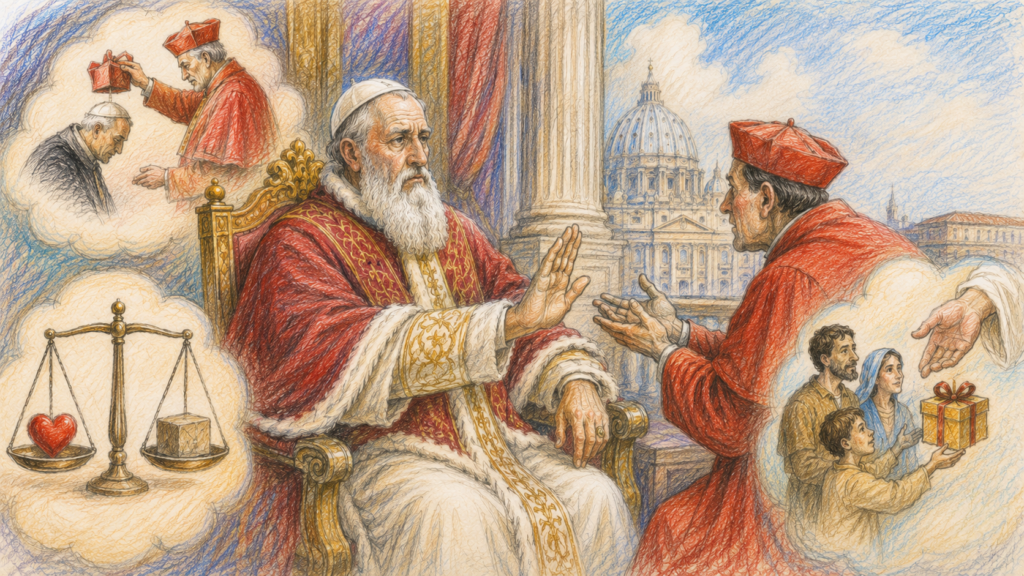
During the pontificate of Paul III, it is said that a cardinal was persistently asking him for a favor. However, Paul III kept putting it off because he was not convinced that he should grant it. In truth, it did not seem to him that it would be fair to grant it, and for that reason, he would not concede. However, he did not want to directly say no to the Cardinal because he did not want to be unpolite.
Every time the cardinal saw the Pope, he would insist that he should grant him this favor out of mercy, until one day he angrily said to him: “Your Holiness, you know very well all that I did to make you become Pope; you cannot, therefore, deny me this favor that I am asking of you.” To which the Pope replied: “Well, you have made me Pope, now let me be one”, meaning, if a Pope uses his power to make unfair favors, he is not acting as a Pope should act because a Pope should not do unjust actions.
Often, what we believe would be an act of mercy is actually an unjust action. Mercy can never be opposed to justice, since, as Sacred Scripture says, mercy and justice meet (cf. Ps 85:10). That is to say, when granting something that is not due or that cannot be given, it is not a merciful act, but rather an act of injustice.
It is true that behind every act of justice there is some mercy, because no one other than God possesses anything in justice unless it was first granted to him out of mercy, as Sacred Scripture says, What do you possess that you have not received? (1 Cor 4:7). Thanks to mercy, everyone has the right to claim in justice what corresponds to him. For example, we received the gift of life, which was given to each one of us out of pure mercy and without any merit of our own —who can merit the gift of life before existing? —, but we can claim in justice to preserve it and to not have it taken from me. We can give many other examples of things which we have received gratuitously: intelligence, physical strength, freedom, etc. An inventor of something can claim copyright in justice for the diligent use of his intelligence to invent the thing, but behind that lies the mercy of God who gave him the intelligence without any merit of his own.
It is also true that when we ask someone to grant us something that violates the order of justice, such as the Cardinal who was asking Pope III for something unjust, we are not asking for a favor by appealing to the other’s mercy; rather, we are asking that person to use his power to act in an unjust way.
As Our Lord explains in the parable of the workers in the vineyard (cf. Mt 20:1-16), the difference lies in the fact that the one who has obtained something in justice may give it out of pure mercy to others. Am I not free to do as I wish with my own money? Are you envious because I am generous? (Mt 20:15), the owner of the vineyard said to those who complained that they had worked all day and he was paying them the same amount as those who had worked only one hour. However, no one can distribute out of mercy something that does not belong to him, no matter how much power or capacity he may have to do so, like the Pope in the Church, because since it is not his, he would be committing an injustice; he would be abusing his power, making himself the owner of something that does not belong to him. Therefore, injustice should never be confused with mercy.