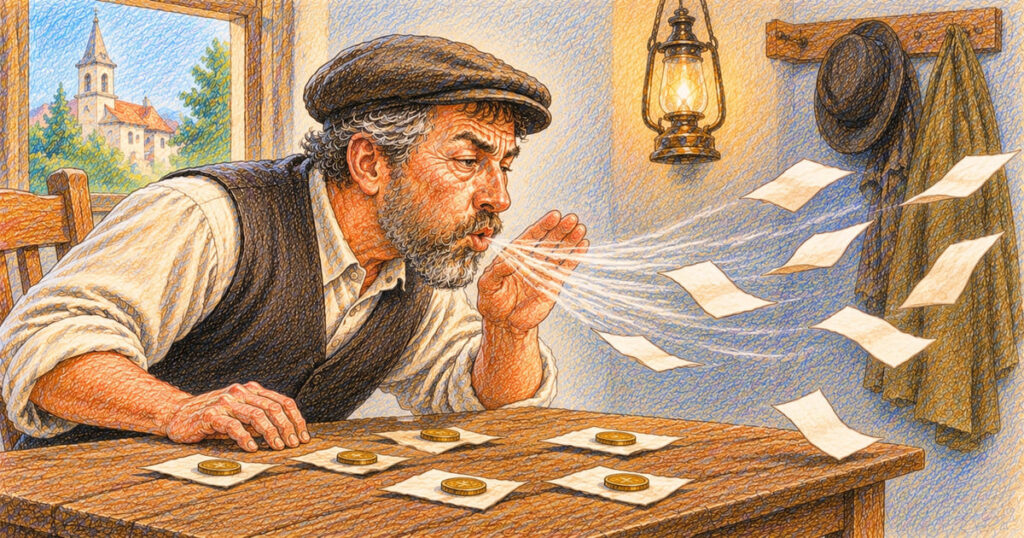
The story goes that Uncle Anton was a man who made his living by running the errands people asked of him. He carried things here and there, from one town to another. The night before each trip he would gather the little slips of paper on which he had written down the errands he had been asked to do, and he would place on top of each paper the coins he had been given as a tip for running the errand. When he finished placing them all on the table, he would blow hard, and all the slips of paper that had no coins on top, the ones for which he had not been given a tip, would fly away and fall to the floor.
Then he would gather up all the ones that had remained on the table and fulfill the errands faithfully. When he returned from the trip and someone asked him about an errand, if he had not done it, he would answer: “Good heavens! The wind must have blown away the slip of paper where I noted down the errand.” And it just so happened that the wind always carried off all the slips of paper that did not have the weight of the tip on top of them.
Doesn’t the same thing happen with many of our errors and faults? Many times, we repent of what we do and even say that we are not going to do it again. However, we fall back into the same error or fault. Why? Because we fail to place on them the weight of the coins, a firm will not to do it again.
To set aside those everyday errors and faults that we habitually commit, it is not enough to say “I won’t do it anymore,” because words, like Uncle Anton’s slips of paper, are carried off by the wind if they do not have on top of them the weight of a firm purpose.
There are two kinds of dispositions in the will regarding those errors and faults. The first disposition is that of ineffective willing, or mere wish: one wants to, but one does not take the means because of the difficulty they entail. It is not a sincere will, because the one who sincerely wants something takes the means to obtain it. Since the willing is ineffective, at the first opportunity one falls back into the same thing.
The second disposition is effective willing, that is, the deliberate and serious will not to do it again, come what may and cost what it costs. When one has this disposition of the will, one has placed on one’s words the weight of the firmness of will necessary to fulfill them.
The lack of this effective willing keeps us subjected or enslaved, since one cannot stop doing that which one wants to stop doing, or one cannot do what one wants to do. On the other hand, when effective willing is achieved, it makes one freer, because it liberates him from something that held him enslaved.