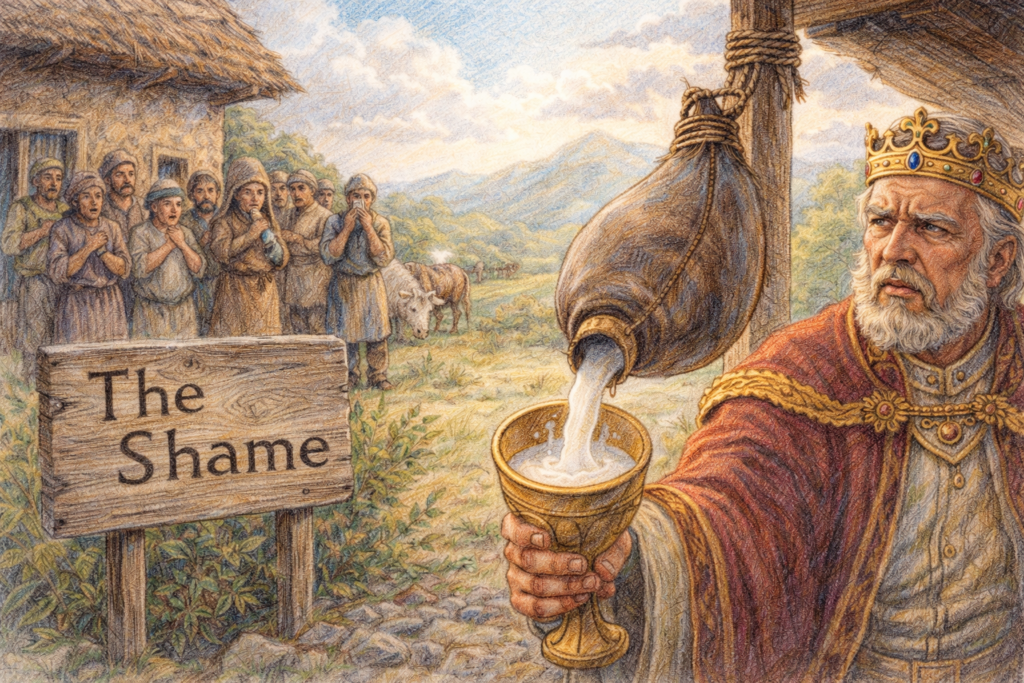
In a distant land, there is a village called “The Shame”. Why such a dishonorable name? The inhabitants have always been very miserly, to the point that merchant caravans try to pass it by.
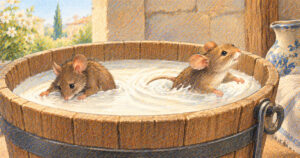
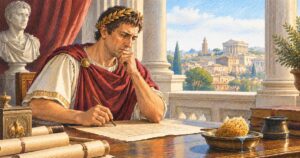
Once, the king passed through there, and the inhabitants of “The Shame” felt obliged to honor him, for he was the king. To prevent the king from thinking they were miserly and lacking in generosity, they decided to place a wineskin full of milk for the royal breakfast in front of the door where the king was staying. The inhabitants had to milk their goats and contribute a portion of milk to fill the wineskin for the king. Each peasant thought that if, instead of contributing 100% milk, they diluted it by 50% with water, no one would notice.
The next day, they left the wineskin in front of the king’s lodging. The king, who had brought his own provisions, decided to accept the villagers’ offering and chose to have the milk they had offered for breakfast. However, when the king and his retinue drank it, they saw that this milk was not milk but rather a whitish liquid that looked like milk but tasted like nothing but: disrespectful, and the situation was nothing more than: a shame.
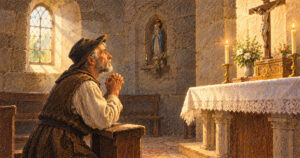
This story can help us reflect on the way we live our Christian life. Often, we live our Christian life as an obligation, just as the inhabitants of The Shame felt obligated to pay homage. When we worship more out of obligation than out of love, our worship ends up being just that—a watery liquid with only the appearance of worshipping God.
On the other hand, if we worship God out of love, it is that love that leads us to give our best in that act of worship we offer to God. In this way, we truly give 100% to Him and not just part of ourselves, having our hearts divided between God (when we go to church) and the world (when we are not in church).
If we worship God only when we go to church, but for the rest of the day we do not concern ourselves with God—that is, we do not strive to fulfill the commandments or order our daily lives according to the principles of the Gospel—then our worship turns into precisely that: a watered-down life that may appear to be worship of God but has nothing of true worship; just as that liquid was not milk and, instead of being an act of honor to the king, ended up being an act of disrespect towards him.
It is important to understand that we should not do this for God’s benefit, as if God needs our worship. Just as the king in the story had his own provisions and did not need the villagers’ milk, neither does God need the praises or sacrifices we can offer Him. God is not more God or less God depending on whether we obey the commandments.
God gave us the commandments, and Jesus preached the Gospel for our good. If we live according to the teachings of the Gospel, the first to benefit from that is us, because the best way to live this life is to live it according to the Gospel.