
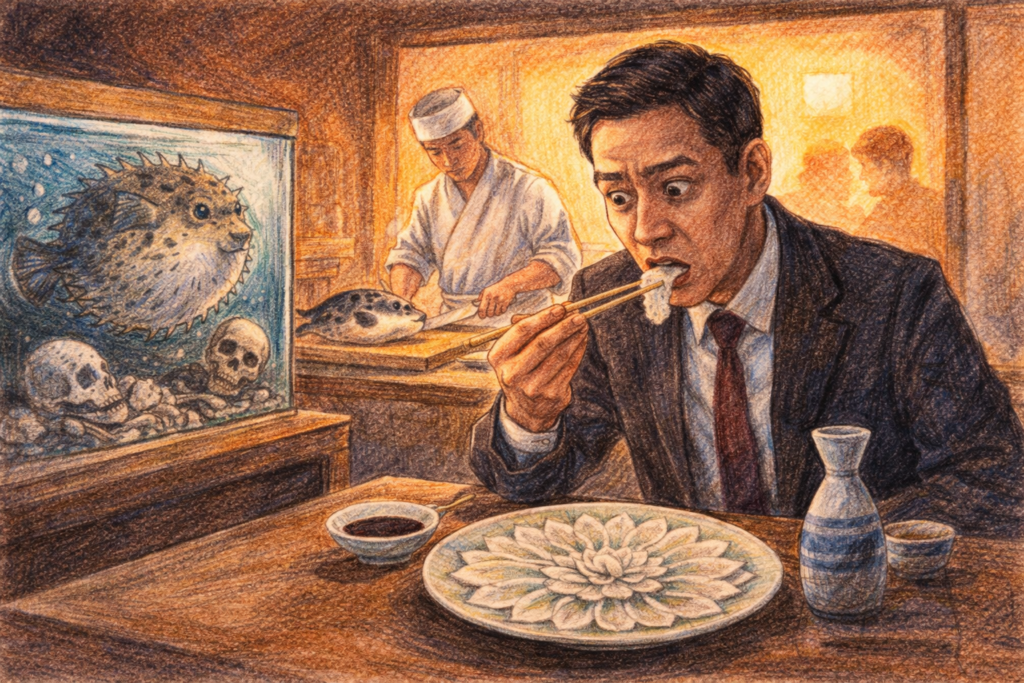
The fugu fish, also known as the pufferfish, is one of Japan’s culinary specialties. It is a delicacy served in hundreds of specialized restaurants in Japan, a country where 9,000 tons of fugu are consumed annually, despite the incredible price usually paid for it. One of the ways it is served is in thin, raw slices, almost always artistically arranged on the plate, imitating the shape of chrysanthemum petals, which is the flower of death in Japan.
Fans of fugu fish highly value its texture, which is a cross between crunchy and chewy, and, of course, its taste. For these people, it is the most delicious of fish. Japanese fugu lovers speak of the sensation a piece of this fish produces on the tongue, a kind of tingling they call shiko-shiko. Above all, however, its consumption is made much more appealing by the risks involved. The most notable sensation they seek is that warm and thrilling euphoria it produces, very similar to the effects caused by eating snake meat. This is the first, and desirably, the last of the symptoms resulting from ingesting poison.
Indeed, the fugu’s body is laden with a neurotoxic tetrodotoxin, one of the most toxic poisons on the planet. Tetrodotoxin is 1,250 times more potent than cyanide, and a single shirako (fugu milt) contains enough of it to kill 30 men. This poison is completely colorless, odorless, and tasteless, making it always impossible to detect it for sure. According to medical studies, nearly 60 percent of people who ingest contaminated fugu die. The person may die from respiratory failure within 6 to 24 hours, depending on the amount of toxin ingested.
This fish is so dangerous that not just any chef is authorized to cook it. A chef in a restaurant that serves fugu must be trained for at least two years, because, when eating fugu, the person places his life in the hands of the chef. Despite all this, one of the things that makes this fish so desirable to some people is the combination of exquisite, refined taste and the risk or thrill of gambling with one’s life with every bite! Someone has aptly defined it as the Japanese “Russian roulette.” We could add that it is an expensive “flirting with death.”
So, this is a splendid symbol of the true and most dangerous flirtation with supernatural death, that in Christian language, we call the occasion of sin. The occasion of sin is any situation in which a person is in danger of falling into mortal sin. It is distinguished from temptation by being an external reality that presents itself as a motive for sin. Temptation, on the other hand, is merely an internal suggestion. The occasion of sin can be: 1. proximate: if the danger of sinning is very great and the commission of sin is almost certain 2. remote: if the danger of sinning is not great;
3. voluntary: if a person freely seeks it out. The voluntary proximate occasion of serious sin is gravely sinful. There is, therefore, an absolute necessity to avoid such occasions.
Those who do not understand the gravity of these occasions of sin and live placing themselves in such occasions are like people who put their lives in the hands of an inexperienced fugu chef. Before putting ourselves in a grave occasion of sin we should remember the words of the Wise man: those who love danger will perish in it (Sir 3:26).