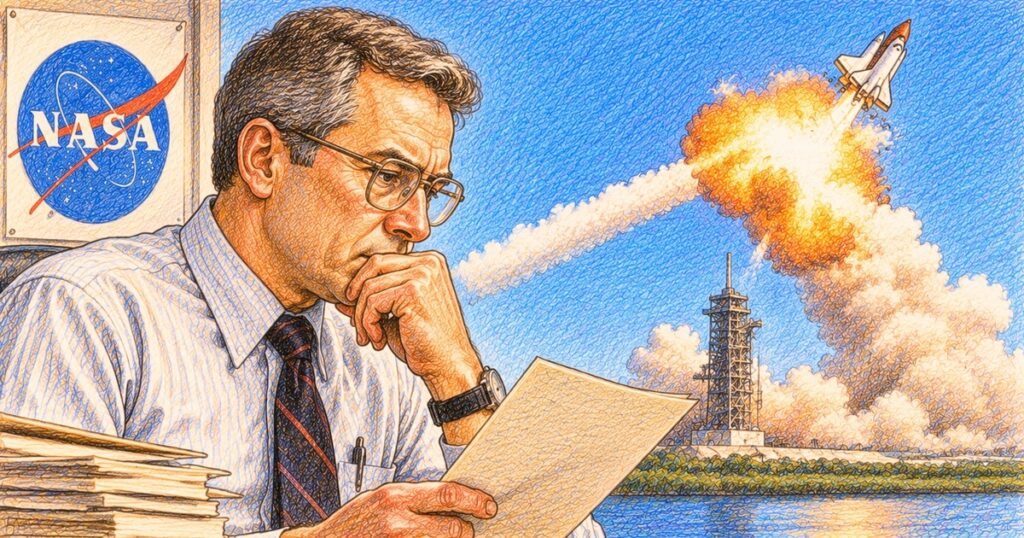
On January 28, 1986, at 11:39:13 AM local time in Florida, USA, the launch site, the first live televised space-race disaster took place. The space shuttle Challenger exploded 73 seconds after liftoff. All 7 crew members of the shuttle died at the moment of the accident. The accident was very well known at that time because one of the crew members was the American teacher, Sharon Christa McAuliffe, who was in the space shuttle as part of the Teacher in Space Project (TISP) and so there was a higher-than-usual media interest in and coverage of the mission.
What is not widely known is that the night before, Allan McDonald, who was in charge of the solid rocket propulsion program for the space shuttles, refused to sign the document giving his approval for the Challenger’s liftoff and asked that the launch of the Challenger be postponed because the necessary weather conditions were not in place.
McDonald and his colleague Roger Boisjoly foresaw that the low temperatures could cause the joints of the fuel storage to stiffen and fail to hold the fuel, producing a leak that would cause an explosion. Which is precisely what happened!
Signing his approval meant putting the lives of the seven astronauts at risk. If he refused to sign, he put his job, his career, and the good life he led at risk. In the end, the weight of responsibility prevailed over his well-being, and he did not sign: “I made the smartest decision I ever made in my lifetime,” he would say years later.
McDonald’s smartest decision was a mature and responsible decision. Mature and responsible decisions come from mature and responsible freedoms. A mature freedom seeks the good because it is good and sets no conditions for doing it. It does the good that must be done even when no one else does it. As St. Thomas Aquinas wrote: “Free is the one who… avoids evil because it is evil” and not only “because God commands it”; this means that a mature freedom is the one that is “perfected interiorly by virtue, in such a way that it abstains from evil out of love [for the good]…; and therefore it is called free, not because it is not subject to the divine law, but because by good habits it is inclined to do what the divine law commands” (Ad II Cor., III, III, n. 112).
A responsible freedom is one that stands up before God, before one’s conscience, and before others for the things he does. Since responsible freedom takes responsibility for the decisions it makes, even the wrong ones, it weighs the decisions well so as not to be mistaken. Responsible is the one who knows how to renounce his particular good and his own interests for the common good, which could be that of the world or one’s own country as well as that of small societies like family, co-workers, friends, team, etc.
A mature and responsible person is moved by serious and well-weighed motives that should be in accordance with his own condition and state in life. However, the first and most important motive is the ultimate goal of life which is the glory of God and the salvation of the soul.