
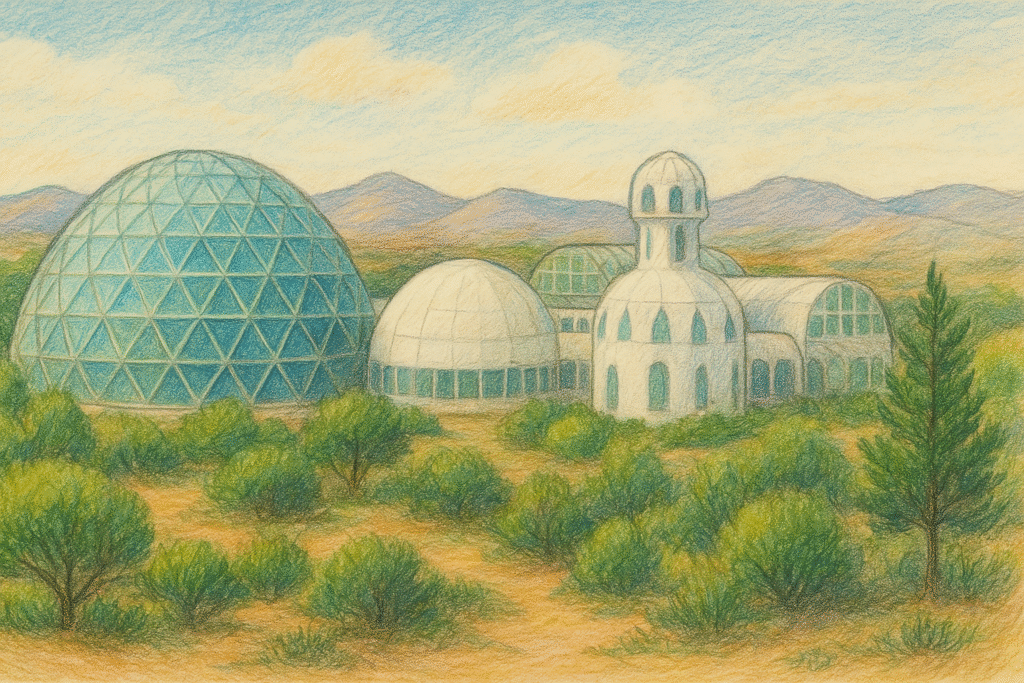
University of Arizona Biosphere 2 is an American Earth system science research facility located in Oracle, Arizona. Originally it was constructed to see the viability of having a city 100% self-sufficient in order to replicate them in other planets as a substitution of the Earth.
This project built between 1987 and 1991 by Space Biosphere Ventures and named Biosphere 2 (because the Biosphere 1 is the Earth itself) faced many problems such as: the condensation which made the desert too wet, population explosions of greenhouse ants and cockroaches, morning glories overgrowing the rainforest area and blocking out other plants, the falling of oxygen, etc. I would like to highlight another problem which was related to the trees.
Rainforest pioneer species grew rapidly, but trees there and in the savannah suffered from weakness which was caused by lack of stress wood which, in natural conditions, is created in response to the wind. Wind makes trees develop a self-defense system that allows them to stay steadfast and not fall. Basically, wind helps strengthen the root system by exerting slight mechanical pressure that stimulates the growth of deeper and more resilient roots.
Temptations are like the wind for the spirit. They make our spirit develop a self-defense system, or virtues, that makes us stronger and more capable to resist sin. The usual means to resist a temptation is making an act of virtue. It could be a direct act of virtue, like when someone has a temptation against faith and he makes an act of faith to reject that temptation. Or it could be an indirect act of virtue, like escaping from the tempting situation.
Those actions strengthen our “system of virtue” and make us rooted more deeply and firmly in grace, because the normal way to grow in virtue is by making more intense acts of virtue. Since virtue is not something quantitative but qualitative, growth does not come from adding quantity, (like the amount of water in a glass that grows by adding water) but rather it comes from adding intensity to the virtue.
For this reason, the stronger the temptation, the more intense the act of virtue it requires and thus the more we grow during temptation. However, this does not mean that we should imprudently expose ourselves to temptation in order to grow in virtue. While it is true that God does not tempt us (cf. Jas 1:13) but rather permits temptation and never allows temptations stronger than our strength (cf. Cor 10:13), it is also true that to imprudently expose ourselves to a temptation is a fault that weakens our virtue.
To take advantage of temptations we should not expose ourselves to them, we should not consent to them and we should face them following the advice of St. Dorotheus of Gaza: “When endured with humility and patience, trials pass without hurting us. But if we insist on being distressed, agitated, and blaming everyone, we are the ones who suffer. The temptation becomes unbearable, and ultimately, it brings no benefit, only harm” (Discourse XIII).