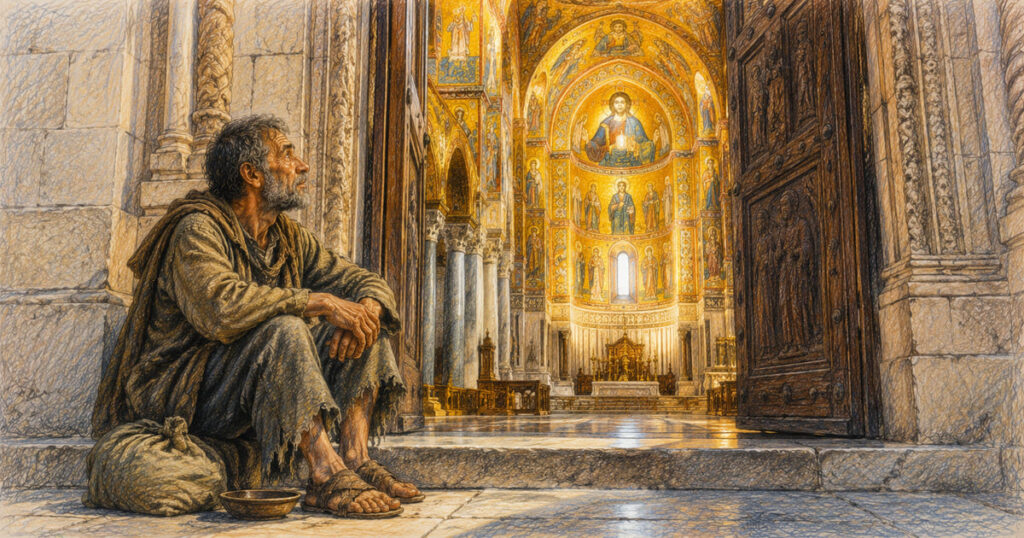
Once, a pagan man went to visit “il Duomo di Monreale” (the Cathedral of Monreale) in Sicily, in order to admire its mosaics. Upon reaching the church entrance, there was a beggar asking for alms. Taking advantage of the beggar’s destitute situation, the man asked him whether he thought it was right for the Church to have a poor man sitting at its door, doing nothing to change his condition, while possessing such great wealth on the cathedral walls—or to have spent so much money building that cathedral instead of giving it to the poor to appease their hunger.
The beggar, who was a devout Catholic, replied: “On the contrary, I am grateful to the one who commissioned this cathedral, because when I enter to pray and see such beauty, it reminds me of the beauty that awaits me in eternal life, and that gives me strength to carry on in this life.”
This is a wise answer, one that we do not always keep in mind when we enter Catholic temples, particularly those like the Cathedral of Monreale or the Basilica of the Sagrada Familia in Barcelona, to name just a couple of the many churches whose art seeks to lift the spirit of the visitor toward God.
The goal of the beauty of church buildings is not for the Catholic Church to be able to boast of its countless works of art, but rather to give worship to God and to move souls toward Him.
First of all, the majestic Catholic temples are built to give worship to God. Just as schools need buildings to educate children, so too a building is necessary to give worship to God. Precisely for this reason, churches are not the result of money being hoarded by a miser, but rather money invested in the worship of God. This is one of the teachings we find in the Gospel of John, when Christ does not rebuke Mary, the sister of Martha and Lazarus, for taking a liter of costly perfumed oil made from genuine aromatic nard and anointed the feet of Jesus (John 12:3); rather, He rebukes Judas Iscariot for complaining that the perfume was not sold and given to the poor.
Secondly, majestic and beautiful temples lift man toward what is above, and thus do great good to the soul, as that beggar in the anecdote so simply expressed. Art is not only one of the manifestations of the human spirit, but it also aids the human spirit; and in the case of sacred art, which is what we are referring to, it aids it in that movement it must make toward God.
The purpose of sacred art is to make the Invisible known to us through the visible. Sacred art seeks to give a face, through images, to the God whom we cannot see with our bodily eyes. It seeks to lead us to the contemplation of the Creator of all things. Hence, the Church has always considered it a necessity to invest money in temples and works of art that help the faithful to lift their souls to God, in order to fulfill the purpose for which She was instituted by Christ.